Grief
I'm Still Here- What didn't kill me made me stronger and sharperGrief in the novel is not confined to mourning the dead: it also gathers the pain of abandonment, betrayal, and love that could not be safely returned. For Jensen McCall and Janae Morrison, losses recur in the present as guilt, fear, self-harm, and difficulty trusting intimacy. Their relationships offer moments of shelter, but neither makes grief disappear; the story instead shows how remembrance and care can help people continue living with it.
Definition and Forms of Loss
Jensen McCall’s grief is layered. He has lost Grace McCall, the adoptive mother who taught him to read, and Chyna, the closest person he had after Grace’s death. He also carries the deaths of Chyna’s son, Mortez Payne, and friends who became a makeshift family. These bereavements sit alongside the wound of never knowing his blood family and the childhood experience of being treated as a temporary guest. His account of sleeping on library steps and being called a foster child gives that history a material dimension: grief is not only sorrow after death, but also the accumulated sense of having no secure home or welcome.
The losses remain distinct, but Jensen McCall experiences them as a recurring pattern. The deaths of loved ones intensify an earlier fear of being unwanted, while abandonment makes each new loss seem to confirm that no bond can last. The novel therefore presents grief as both an emotional response to particular deaths and a continuing condition shaped by what was missing before them.
Jensen McCall: Bereavement and Survivor Guilt
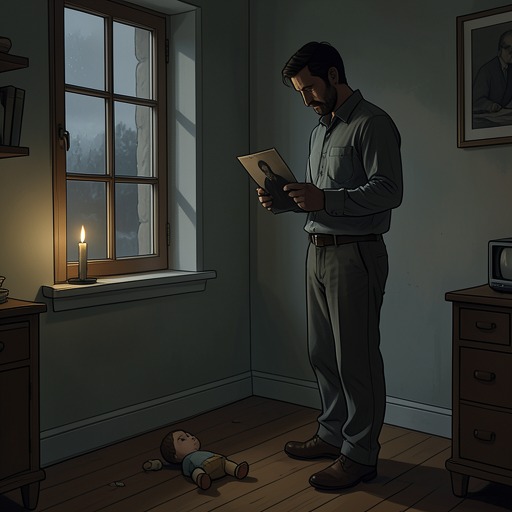
Chyna’s death is central to Jensen McCall’s grief because it is inseparable from his belief that he failed to save her and Mortez Payne. Chyna admitted to the gang that she had spoken to federal agents, taking the blame for Jensen McCall’s act of betrayal. She and her son were then brutally murdered. Jensen McCall remembers holding their bodies, closing their eyes, and rocking them; Mortez Payne still clutched a Transformer that Jensen McCall had given him for Christmas. The small, specific gift makes the scene especially painful: the child’s ordinary attachment remains visible amid the violence.
Jensen McCall’s grief turns into self-accusation. He understands the deaths as punishment for his own actions and condemns himself for having done nothing to prevent them. Yet Chyna’s last words, as he recalls them, rejected that blame and urged him to become somebody great. Her attempt to spare him does not resolve his guilt. Instead, her death becomes both a burden and a charge: Jensen McCall reports the crimes to Detective Dartes and frames his later search for his birth mother as part of a larger effort to find justice and purpose.
His loss of Chyna is also the loss of a relationship that could never take the form he wanted. They met in a foster home, defended one another against sexual abuse by other residents, and became close as siblings and friends. Jensen McCall loved Chyna, while she regarded him as a big brother and believed friendship was safer than romance. After her death, he remembers both her loyalty and the unreturned part of his love. Grief preserves the tenderness of their bond but also keeps its limits and regrets alive.
The deaths of his friends extend this pattern beyond one relationship. Remembering the first people who treated him like a human being, Jensen McCall recalls their meals, dry clothes, games of basketball, and joking together. He is angry that they ignored his warning to leave Brick Town alone, but their deaths also leave him with another chosen family gone. He tries not to cry and then does, a change that makes visible how much loss has accumulated beneath his guarded manner.
Janae Morrison: Grief, Betrayal, and Crisis
Janae Morrison’s grief is entangled with romantic betrayal. While recovering from the killing of a former partner, she learns that her sister was also involved with him and is pregnant with his child. The revelation compounds bereavement with humiliation and the sense that the relationship she trusted was not what she believed. At the hospital, Janae Morrison explains that these discoveries pushed her toward a breakdown; she cries as she speaks, while Jensen McCall holds her hand. His presence does not undo the loss, but it gives her support at a moment when its consequences have become acute.
That crisis includes a history of cutting and a suicide attempt. The medical staff explain that the hospital’s policy would ordinarily require three days of mental-health evaluation after an attempt, but Janae Morrison has no insurance and the hospital does not participate in Medicaid. They offer release on the condition that she sign a contract and enter a free program combining group and individual dialectical behavior therapy. The scene places her pain beside the practical limits of care: support is offered, but access to treatment is shaped by financial and institutional circumstances.
Janae Morrison’s grief also returns through her relationship with Jensen McCall. She later says that she uses cocaine to forget that her mother does not love her, her mistakes, and her inability to stop using. Her relapse is not presented as a simple continuation of bereavement, but as part of a wider effort to escape painful feelings. Jensen McCall’s departure after discovering that she has hidden her drug use makes the fragility of their support plain: his care is real, but deception and addiction strain the trust on which their relationship depends.
Memory, Repetition, and the Living
Jensen McCall’s own account of a near-suicide attempt helps explain why he responds so strongly to Janae Morrison’s despair. On the night of his high-school graduation, no one came to celebrate his achievement. He bought a gun, stood behind a building, and nearly shot himself before rain interrupted the moment and he buried the weapon. He shares this memory while Janae Morrison is struggling with thoughts of death, telling her through his experience that she is not alone. The disclosure turns an earlier episode of grief and isolation into a form of witness: his past cannot make her pain vanish, but it allows him to recognize it without pretending it is unfamiliar.
That exchange offers closeness without promising a cure. Later, Inya advises Janae Morrison that a wounded heart can place a recovering addict at risk of returning to drugs, and that she can control her response even when she cannot control another person’s feelings. Inya speaks from her own history: after a drug binge, she slept through the murder of her nine-year-old daughter; following repeated suicide attempts and psychiatric hospitalization, she got clean, went to college, and dedicated her work to helping others. Her loss remains part of her life, but it also informs the care she offers. The narrative presents this transformation as a way grief can shape service, not as proof that bereavement has been erased.
The novel also returns to grief through threatened loss. When Ginger Pearl collapses, Janae Morrison cries, a family member shakes uncontrollably, and Jensen McCall pleads for his grandmother to live. The defibrillator and Ginger Pearl’s small movements bring a momentary reprieve, but Jensen McCall’s fear immediately recalls finding Grace McCall collapsed and being unable to save her. As he accompanies his grandmother for medical care, he regrets that anger kept him from showing more love during their earlier reconciliation. The threatened death revives the old bereavement rather than replacing it.
Significance
Grief links the novel’s distinct histories without making them interchangeable. Jensen McCall’s guilt over Chyna and Mortez Payne, his longing for the mother who abandoned him, and Janae Morrison’s mourning and addiction each arise from different circumstances. Yet each loss can return unexpectedly through a gesture, a disclosure, or a medical emergency. The repeated movement between memory and present crisis gives grief a cumulative force: survival does not mean forgetting, and a new bond does not simply substitute for the dead or the absent.
The book’s counterweight to that recurrence is not easy closure but witness and chosen care. Jensen McCall reports the violence that killed Chyna and Mortez Payne, listens to Janae Morrison, and shares the story of his own despair; Inya turns painful experience toward helping others. These acts do not settle every debt or guarantee recovery. They show instead how grief can be acknowledged rather than carried in silence, and how connection may make continued life possible without pretending that the losses have stopped mattering.